Friday, November 4, 2011

Sariputta World Peace Walk -2011

Walk the Path through Bihar to Vihara


Nava Nalanda Mahavihara, in collaboration with the Bodhgaya Temple Management Committee, has conceived a series of events tied with the theme “Walk the Path through Bihar to Vihara.”
Invitation Card

The objective of these events is to increase awareness of the rich Buddhist legacy of Bihar among the locals as well as at the national and international levels. The Revival of the Ancient Buddhist Pilgrimage as mentioned in the Buddhist literature is the main focus of these events. The three chief disciples of the Buddha, Sariputta, Maha Moggallana and Maha Kassapa are an important aspect of the pilgrimage and the places and events associated with their lives in the main focus.

As per traditional records, Sariputta attained parinirvana on Kartik Purnima and fifteen days following it Maha Moggallana attained parinirvana on Aghana Amavasya; these events took place just six months before the Mahaparinirvana of the Buddha on Veshak Purnima. The awareness events would likely be around these dates based on the lunar calendar.

Nava Nalanda Mahavihara (Deemed to be University), Bodhgaya Temple Management Committee and the District Administration-Nalanda has joined hands for celebrating one such event, ‘the legacy of Sariputta’ and have organized the 2nd “Sariputta World Peace Walk” to be held on the 12th of November 2011 at Giriyak Hill, part of the “Sariputta Zone.”

All studies to date lead us to believe that Giriyak Hill is the area of Sariputta’s Parinirvana Stupa as visited by Fahein (5th CE) and Xuanzang (7th CE). Their travelogue entries correspond to the area consisting of the villages of Nanand, Chandimau and Giriyak. Great effort is being exercised to develop this area as the ‘Sariputta Zone’, a place to pay tribute to this “Son of the Soil.”

In 2010, the first Sariputta World Peace Walk was a big success and received positive response from the local community and the Bhikkhu Sangha. Involving of local school children at a young age about their own heritage is also a focus in the revival process.

It is time yet again to reunite our efforts and pay respect to our heritage and celebrate the legacy that is ours!


Tuesday, October 25, 2011

42nd Anniversary Celebration of Vishwa Shanti Stupa- Griddhkuta, Rajgir

Vishwa Shanti Stupa (World Peace Pagoda) was conceptualised by  Most Ven. Nichidatsu  Fujii of Nichihonzan Myohoji sect that emerged from Nichren School. The Foundation stone of Vishwa Shanti Stupa was laid by President Dr. Radha Krishnan in 1965 and inaugurated by President Shri V. V Giri in 1969.
 Shri Upendra Maharathi ,noted architect and artist, played an important role in its design and architecture.

Most Ven. Nichidatsu  Fujii
Rope Way.....an easy way to reach to the top..
The Vishwa Shanti Stupa was constructed at Ratnagiri Hill behind the Griddhkuta hill because it was at Griddhkuta that the Buddha delivered the Saddharma Pundarika Sutra the basis of Nichiren Sect. Also Rajgriha( Rajgir) is an historical place and was capital of the Ancient Magadha Empire. Ven. Fujii Gurujee believed Rajgriha played an important role in the installation of the Buddha as a religious leader.
The Majestic Vishwa Shanti Stupa.....Celebrating its 42nd Year
Ratnagiri Hill getting ready for the occasion...
Ven. Dhammajyoti with the Invitation card....
Pilgrims and devotees  from Japan......

Memorable moment for the Japanese Pilgrims....
Ven Okonogi Ji and Smt. Mahasweta Maharathi Ji....Pillars behind the annual show
Peace drum.........to spread peace vibrations in the cosmos...
Magnificient Bihar reports......
The Offerings and the portrait of most Ven. Fujji Guruji
Monks and Nuns with the Offerings enter the arena...
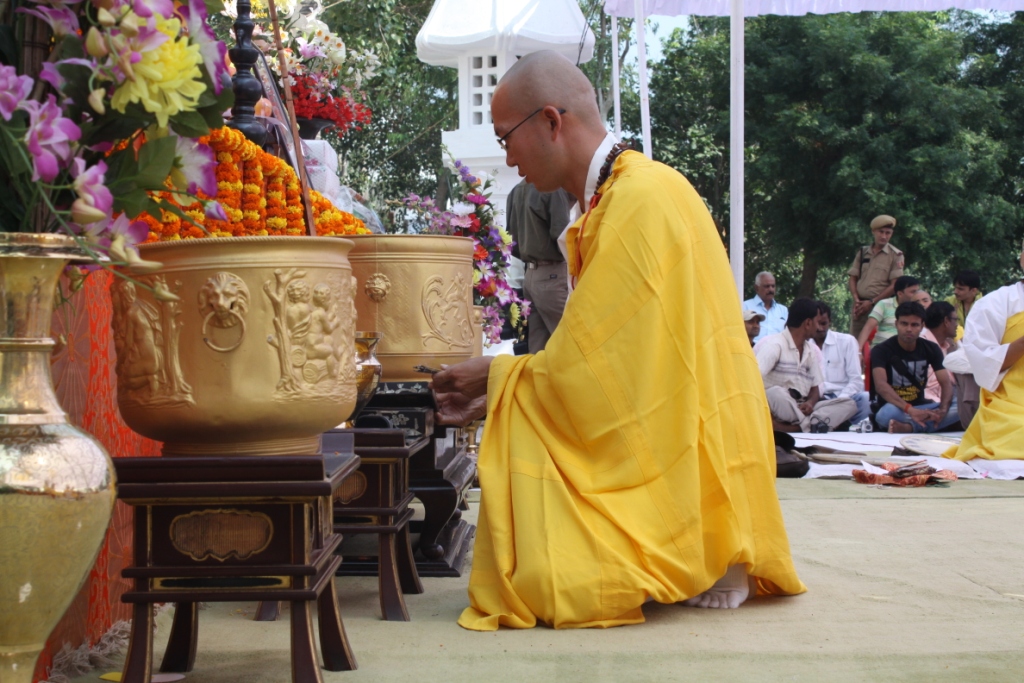
The prayers by the Monks and Nuns
Hon. Chief Minister of Bihar Shir Nitish Kumar Ji arriving at the ceremony
Monks and Nun chanting the Saddharma Pumdarika Sutra
Offering incense....
Chief Minister Shri Nitish Kumar ji offering his prayers
The World Peace Pagoda is a symbol of Peace. Thousands of pilgrims and visitors visit this place every year and pray for peace by circumambulating the Peace Pagoda. The Chief Guest Shri Nitish Kumar Ji also took the circumambulating path around the peace pagoda drumming the traditional peace drum.


The CM and others Circumambulating the Peace Pagoda in clockwise direction
Thervada Monks offering the Prayers
The CM making his speech......Vishwa Shanti Stupa a symbol of Indo-Japanese friendship...
Exchange of Gifts....
The Chief Minster offering Memento to the Delegates from Japan
The Japanese Delegation ....

Tuesday, October 11, 2011

Government acts to safeguard Barabar Hills

The Beautiful  Barabar Hills
Prompt action by Department of Youth, Art and Culture, Government of Bihar has brought temporary relief to the Heritage of Barabar. The rampant mining activity at Barabar has stopped but still the question is for how long.
TIMES OF INDIA Reports 
I spoke to few villagers at Dharawat, Kuri Sarai and Dakra and all of them confirmed about raid conducted by District Magistrate. They felt this was indeed a good step but this is not enough in long run.
The hills are surrounded by villages and the mafia active in illegal mining operates from these villages.
Villagers said, such raid brings temporary relief and the mining resumes after few days.

Some long-term measures could be,
1- Blocking the access to the hills
2- Awareness generation drive in and around Barabar hills
3-Notice boards with warnings
4- 24Hrs Helpline so that people can report any suspected activity

Letter issued by the Department


Sunday, October 9, 2011

Sound & Light Show for the Buddhist Circuit

Ms Virat Husain, officials from Tourism Department and Myself at Ghoda Katora Dam
Department of Tourism, Government of  Bihar is planning to have Sound and Light Show at important sites along the "Footsteps of the Buddha" circuit in Bihar.
 Ms. Virat Husain and Rahul from "Stagedoor", a Gurgaon based organization.conducted  recce of Mahamaya Sarovar, Bodh Gaya, Ghodakatora Dam and Pandav Pokhar, Rajgir and Xuanzang Memorial Museum, Nalanda, on 3rd and 4th Oct-2011.
 

Friday, September 30, 2011

Xuanzang- Footsteps that time cannot erase

Xuanzang is not a familiar name in the school history books so the first time I heard it, it rang a bell. I was intrigued to find more because all of facts related to Buddha in Nalanda and vicinity were cross referenced with Xuan Zang’s travelogue.

Being a traveler myself and having experienced many cultures I wanted to know more about the Chinese scholar who travelled to India via the silk route. My first detailed encounter with Xuan Zang was these travel guide maps that were developed as a part of the Explore Rural India project, when Deepak asked me to edit some of the passages.

Xuanzang Circuit for Nalanda and Rajgir
XuanZang traveled through various important sites related to Buddha and Buddha’s teachings several centuries after Buddha’s parinirvana and wrote extensively about them in his travelogue. After the 12 century Turk invasion when all the visible sign of Buddhism were obliterated from Magadha region, there was no way to even confirm that the roots of Buddhism lay buried deep in this landscape. The original structures were either buried in layers of soil or surrounded with local legends, the bricks and pillars were used to support new structure and the teachings lived through festivals and traditions among the people here. It was then Xuanzang’s travelogue that came to the rescue of the early Orientalists who tried to solve this puzzle.

Add caption
Soon after I was introduced to XuanZang’s history, I got the opportunity to tour the sites of Nalanda that were mentioned in travel brochure and I was thrilled to see what was left and enthralled to imagine what must have been. Deepak and I discussed the possibilities and ways to share this heritage and knowledge with those who might be interested but are unaware. Out of the continued discussions were generated many ideas about how the information that we have can be shared, preserved and most important of all be beneficial to the community that lives with these treasures.


Some of these ideas have already sown the seeds and you have read about them on this blog; others are still in the making. The Nalanda (Nalanda-insatiable in offerings & Nalanda on the move) blogs were our way of sharing the history and our progress while keeping tabs on our goals and ultimate destination.

While on the excursion to Nalanda, I visited the Xuanzang Memorial and Museum, which is built a short distance away from the Nalanda University ruins. The building and its inspiration both come with a very interesting history, and I (along with the rest of the team) get to share it with you.

Cover page of the Souvenir Booklet
We are excited and humbled as we share this book with you. A book that began with a casual conversation and was carried forth with much enthusiasm and passion, to explain to the visitors of Xuanzang Museum who ‘Xuanzang’ really was and how much he contributed to our history.

Xuanzang's Statue at Xuanzang Memorial
Once the idea of the book sunk in, Deepak came up with the basic set up about how to best share the complete story without losing the interest of the reader and segregated the information into chapters and visuals. While Deepak poured over the facts about Xuan Zang’s journey, the path he took and the time and hurdles he passed and other important events of the journey, I worked on the details about Xuanzang’s life history, his motivation to travel to India and then the reasons he chose to write his travelogue. During this time, Dr. Pant who is the director of Nav Nalanda Mahavihar acted as our anchor; he made sure I don’t take many writers’ liberties over the hard core fact and closely guided Deepak as he developed the exact route maps and the timelines. We discussed the Architectural details of the structure and how it has been inspired from Chinese architecture which in turn in some situations was an adaptation of Indian structures of the time. We all worked in close collaboration and went around circles many times and churned out a concise book about Xuanzang, who he was, what inspired him and how his contributions added to the spread to Buddhism, not only in China but other South East Asian countries including India. The route maps in the book are one a kind and have been created with great precision and thorough research.
Maps depicting journey of Xuanzang prepared by AVIWEB.IN

Although working on a project like this with our team, two members that are 8000 miles and 11 hours apart and the third one who bears the responsibility of an entire university and travels frequently, was very challenging but getting the final product to print was whole another saga. Here’s the rest of the team:

Foreword- Governor of Bihar, H.E. Debonand Konwar
Authors- Dr. Ravindra Panth, Shalini Nigam, Deepak Anand
Editing and proof reading- Monica Harvey
Pictures- Alok Jain.Yves Guichand, Dinesh Mehta
Design- Ashutosh,
Printing- Northern Publishing centre,
Front Cover- Saurabh
Cover picture contributed by Saurabh-  Xuanzang being welcomed by monks of Nalanda

A big pat on our backs for all the hard work and most importantly the great teamwork.

There were as many iteration if not more for the format of the book as there were for the original content, but in the end it is what we wanted, a book that is within reach of every visitor that come to see Xuanzang Memorial. Or perhaps one would find a copy and would be inspired to visit and pay a tribute.
Entrance gate of Xuanzang Memorial Museum, Nalanda
It was released in a small ceremony by the current honorable Governor of Bihar ‘H E Debonand Konwar’ on the 25th September in Patna. The day in pictures follows:

Book Released by H.E. Governor of Bihar Shri Debonand Konwar and  Dr. Panth, Director Nava Nalanda Mahaivihara

Alok Jain (L), Dr Panth, H.E. Governor, Deepak Anand (R)

Lunch hosted by Governor

Governor Perusing the Booklet


A view from Governor House