"Journey of the Heart"
A Heart-Felt Tribute to Venerable Xuanzang
A US film crew, headed by Amardeep
Kaleka, with fellow production crew, Ole Brereton and Noah Woodburn, visited Nalanda as a part of the filming of the movie, "Journey of the Heart," which follows the footsteps of Xuanzang. Filming in Nalanda from the 26th of January to the 2nd of February, the crew filmed at several of the important places visited by Xuanzang that were associated with the Buddha.
The Team
 |
Ravi Verma, the man behind the concept and also
the producer of this grand project |
 |
| Amardeep Kaleka.....The Director |
 |
| Ole Brereton....Assistant Director |
 |
| Noah Woodburn...Sound Recorder |
 |
| Monica Harvey.......Logistics |
"Journey of the Heart," a documentary, is about the
Heart Sutra, the Buddha, and Venerable Xuanzang's journey. Shooting at Sarnath, Kushinara, Vaishali, and Bodh Gaya, the team eventually arrived at Nalanda to capture the places associated with Venerable Xuanzang; sites in and around Nalanda and Rajgriha. We know Xuanzang took a pilgrimage to the holy land of India to pay his homage to the land of the Buddha and to collect manuscripts of the Buddha's teachings.
As site interpreter for the film crew, it was my desire to pay my tribute to this important world citizen whose contribution to mankind is unfathomable; a feeling that cannot be expressed in words. My intent was to share Xuanzang's journey in and around Nalanda with the world. No words or emotions can truly do justice to the emotions that must have overflowed when Xuanzang reached Nalanda, after years of trekking through insurmountably difficult mountains, glaciers, hot plains and near death situations.
We owe the rediscovery of our heritage, the cultural past, to the Master Xuanzang, who with meticulous details recorded events in this area. Our effort with this documentary is to let the world know this heritage and how much we collectively owe to Venerable Xuanzang.
Remains of Ancient Nalanda University
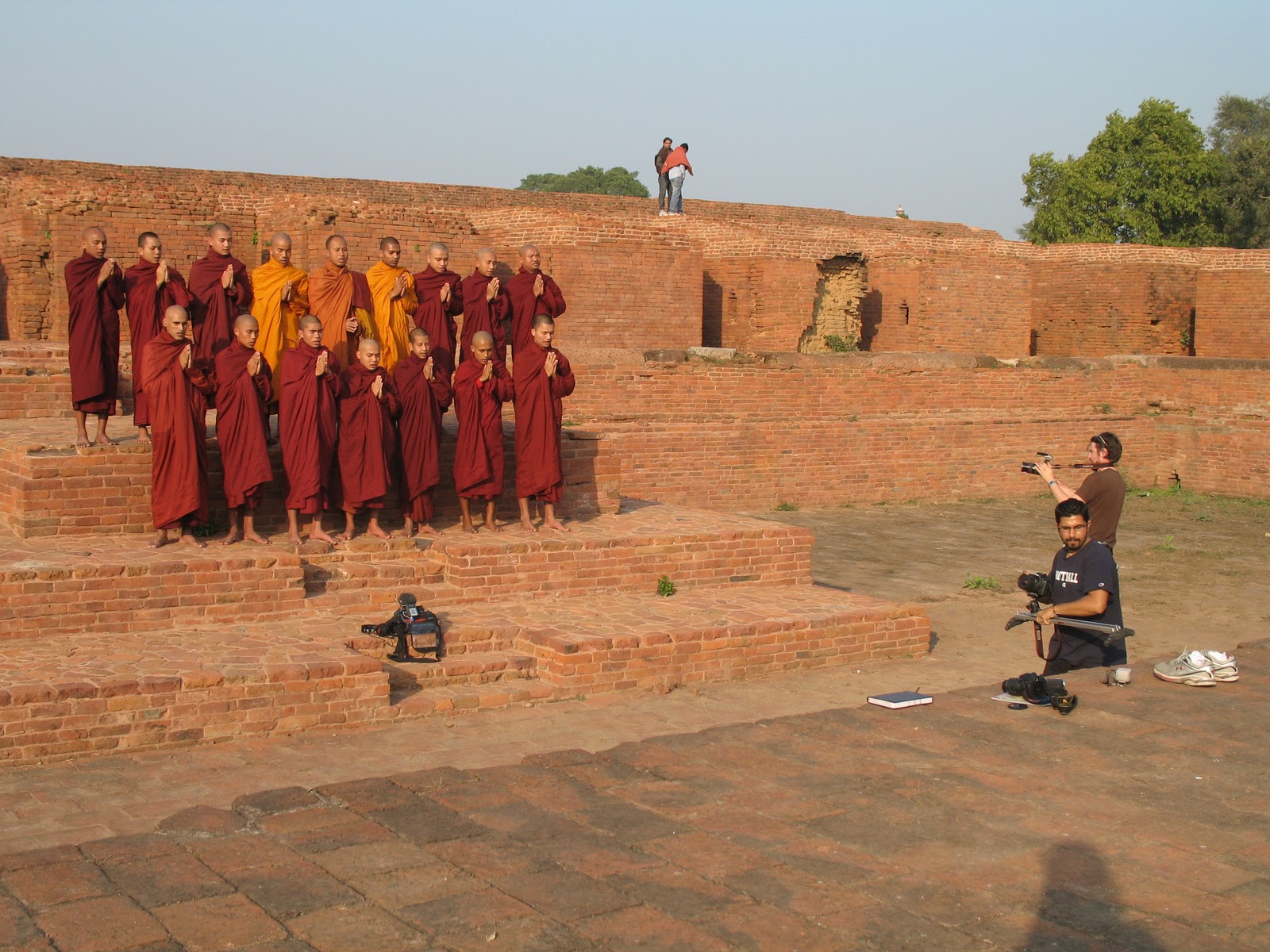
Xuanzang was received by the monk community and the laity at Nalanda, staying here for about 15 months. Visiting the Ancient Nalanda University, the film crew tried to capture the essence of Venerable Xuanzang's visit with help of monks from Nava Nalanda Mahavihara. Chanting, an integral part of the day-to-day life at Nalanda, was once again demonstrated as the film crew did its best to capture this ancient tradition.
 |
| Monks chanting at the Ancient Nalanda Ruins |
 |
| Monks receiving directions from director, Amardeep |
Manuscript Library, Nava Nalanda Mahavihara
Xuanzang carried valuable Buddhist manuscripts back to China to transcribe into Chinese. The film crew visited the Nava Nalanda Mahavihara Manuscript Library to shoot ancient manuscripts. Viewing the various types of manuscripts from Tibet, Cambodia, and Myanmar, the film crew tried to show what the Buddhist texts Venerable Xuanzang carried must have looked like and how difficult it must have been for Xuanzang to collect the extensive texts and transport them back to China.
 |
| Viewing the ancient Heart Sutra in Tibetan |
Xuanzang Memorial Museum
The Xuanzang Memorial Hall was constructed as a joint effort between China and India to commemorate the great efforts of Venerable Xuanzang. Dr. Panth, the director who renewed construction and saw the completion of the Hall, is the authoritative expert to describe the Heart Sutra and momentous contribution of Venerable Xuanzang to the larger of mankind.
 |
| Interview with Dr. Panth, Vice-Chancellor of Nava Nalanda Mahavihara |
 |
| Xuangzang Memorial Hall |
 |
| Re-creation of ancient script writing with help of Dr. Lalan Jha |
Indrasaila Guha, Parwati
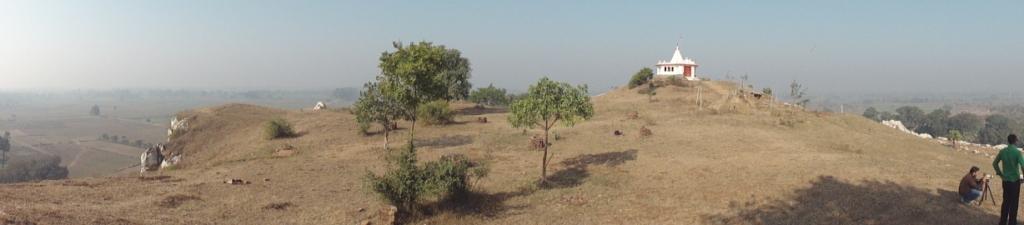
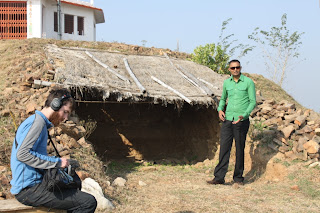
Parwati was an important pilgrimage place and among one of the many places that Xuanzang visited. As the film crew had only a few days to shoot, this important site, among the many, was deemed a must to visit. In a cave at the top of the hill, Buddha sat to meditate. Xuanzang must have become very emotional to find this place where the Buddha meditated and to see the brick stupa erected in honor of the Hamsa (Swan). Perhaps Xuanzang also added his own bricks to the stupa, now covered by grass and a Bodhi tree.
 |
| Ole, followed by village children |
 |
| Picturesque Parwati hill |
 |
| Noah attaching the microphone to me |
 |
| Discussing the Shot |
 |
| A stupa and its exposed layers of reconstruction |
 |
| Local villagers, film crew, and stupa mound (in background) |
 |
| Expressing Xuanzang descriptions to the camera |
 |
| Reflection of Xuanzang on Camera |
 |
| Talking to the inquisitive local community |
Vulture's Peak (Griddhkuta)
Talking about Vulture's Peak was a real challenge as this place was very close to the heart of Xuanzang. All the way along his journey, his desire was to survive the arduous journey and near death situations in order to reach Vulture's Peak and bend his legs at the place where the Buddha delivered the Heart Sutra.
 |
| Finding the right spot to capture the feelings of the Xuanzang |
 |
| Getting ready for the Shot |
Gurupada is the place associated with the Maha Kassapa, the third important disciple of the Buddha, who exchanged robes with the Buddha, as the story goes. Xuanzang visited this place and gave a description about Maha Kassapa, his association with the Buddha and his valuable contribution to the Buddha, the Dhamma and the Sangha. Xuanzang also talked about the Matriyea Buddha, the future Buddha, who will come here to Gurupada to collect the robes of the Gautama Buddha, which were kept with Maha Kassapa. This important event makes Gurupada a very appropriate site to showcase the sublime elements of the story of the Buddha.
 |
| Children from Gurpa village.....collecting firewood |
 |
| getting to the top of the 1500 Ft high hill |
 |
| a short break for the crew.....the climb is very steep!! |
 |
| Place where the Maha Kassapa took Samadhi |
 |
| Ven Dhammadeepa gettting ready for the shot |
 |
| The Picturesque Gurupada!! |
 |
| Noah ..celebrating the day and the good shoot!! |
 |
| A group picture before the 30 Minute climb-down... |