Tuesday, November 23, 2010

Peace Walk today...

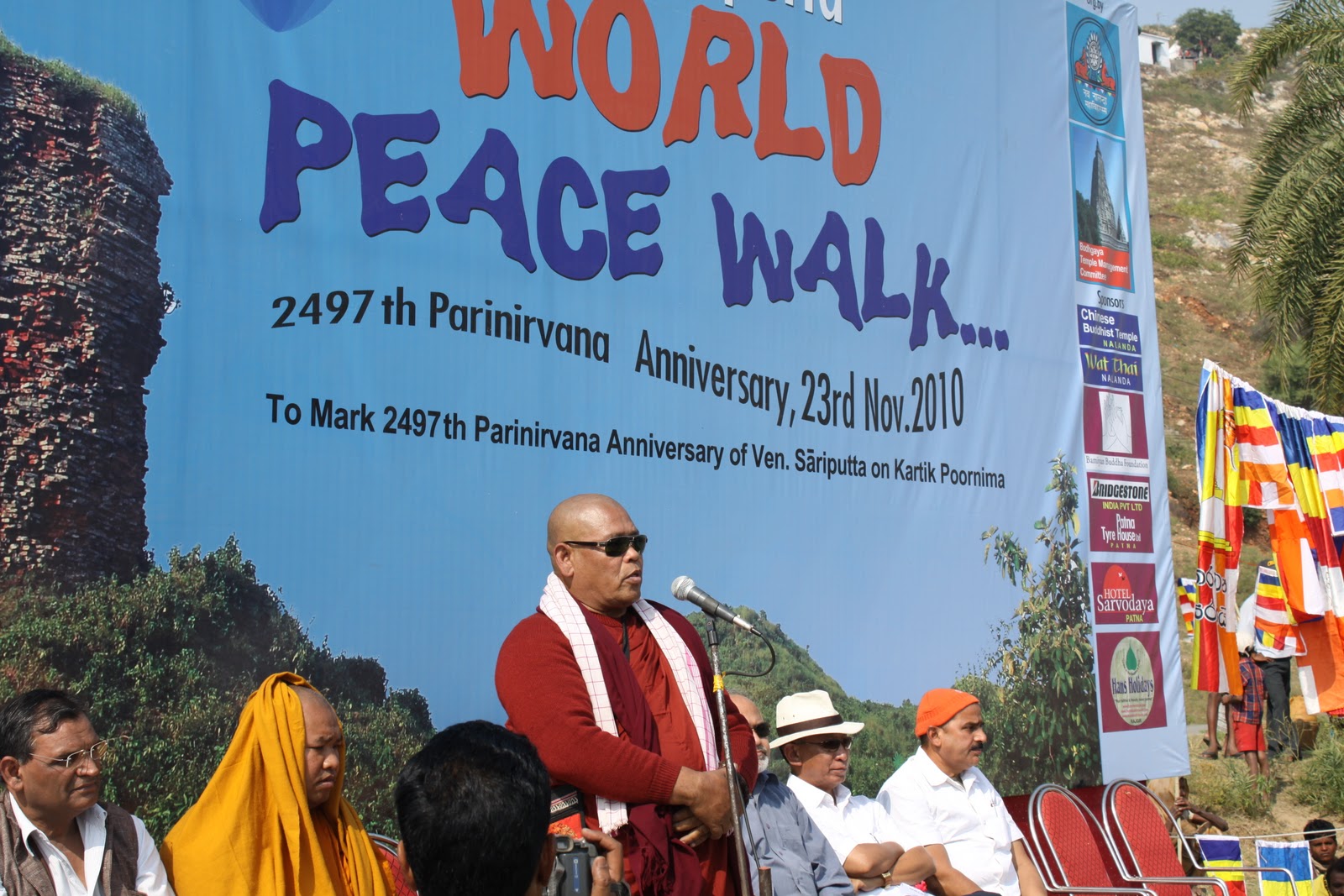
For the first time in the history of Bihar, son of the soil, Dhammasenapati Ven. Sariputta was remembered on the occasion of 2497th Parinirvana year in his homeland. As the part of the event a ‘Sariputta World Peace Walk” was organised jointly by Nava Nalanda Mahavihara, Nalanda (Deemed University) and Bodhgaya Temple Management Committee, Bodh Gaya.
As a part of the event in the morning, monks from various Buddhist countries assembled along with participants from BTMC, students, teachers and staff of NNM at the foothills of the Giriyak Hill, Giriyak. It was almost to the amazement of the organizers a group of local community from Chandi Mau, Nanand and Giriyak were assembled to welcome the Bhikkhu Sangha.
 A brief Ceremony of 1 hour was organised in which the famous Sammādiţţhi Sutta of Pali Canonical Text given by Ven. Sariputta was chanted by the Ven. Bhikkhu Sangha. Thereafter the speakers in their address expressed, that this zone comprising of villages Chandimau, Nanand and Giriyak be preserved, developed and promoted as Sariputta Heritage Zone.


Dr. R. Panth, V. C., Nava Nalanda Mahavihara
 Address by Ven. Phra Vithun Putāni, Thailand


Address by Ven. Dr. Pannyalinkara, Head Abbot of Chinese Buddhist Temple, Nalanda


Bhikkhu Sangha chanting Sammādiţţhi Sutta

Shri Rajkumar singh from Chandi-Mau


Our Sponsors

Wednesday, November 17, 2010

Sāriputta World Peace Walk- Launch of Promotional material

Launch of the Promotional material of the 
Sāriputta World Peace Walk

On 17th November 2010, Promotional material for the world peace walk was launched in a small function at Bodhgaya Temple management committee Office at Bodh Gaya.

Shri Nangzey Dorjee, Member Secretary of the BTMC , Dr. R Panth , Director, Nava Nalanda Mahavihara,  Bhikkhu Chalinda, Chief Priest Mahabodhi temple,  ven monks from different monasteries and other guests were present at the small gathering to discuss the course of action to make this walk a success.


Launch of the Stickers


Launch of the Wall Poster

The Hoarding at the main entrance of Mahabodhi temple


Wall poster at the Main Entrance of Mahabodhi temple

Saturday, October 30, 2010

Sāriputta World Peace Walk- A new begining in the revival of the Ancient Buddhist Pilgrimage

The Legacy of Sāriputta and Mahā Moggallāna

Sāriputta (also Sāriputra) and Mahā Moggallāna were highly revered by all for their contribution to the Buddha, the Dhamma and the Sangha. Buddhist literature mentions that monks and devouts have paid homage to the Parinirvana Stūpa of Sāriputta. One thousand years after his Parinirvana, Fahein visited Sāriputta’s Parinirvana Stūpa. Xuanzang too in 7th century CE, visited the Ashokan Stūpa made to mark the Parinirvana of Sāriputta. Pali literature states that Sāriputta and Mahā Moggallāna were from villages in proximity to Rajgriha (
SA.ii.172). Pali literature also mentions the village, Nālaka (also Nāla, Nālika and Nālagāmaka), where Sāriputta attained Parinirvana (S.v.161; J.i.391; v.125; UdA.322). Fahein corroborates this by mentioning the name of the village, Nala, and Xuanzang mentions the name, Kālapināka. The place mentioned by Fahein and Xuanzang is present around Giriyak Hill. Although not absolutely confirmed by research, the scenic place around the Giriyak Hill was once the hub of Dhamma activities and what better place than this mighty Stūpa on the top of the Giriyak hill overlooking this entire vast surroundings to pay tribute to this great monk, Sāriputta, who was considered as the right hand of Lord Buddha.

The Place (Giriyak Hill)

The Giriyak Hill (25° 01’ 28 N, 85° 30’ 51 E) is the last point (peak) in the east where the Rajgir hill range abruptly ends.


Fig-1-Ancient Brick Stupa


Fig-2 - Huge Stone structure with Brick stupa on the top


View of Panchane river from the top of the Giriyak Peak


Ancient Pillars lying on the hill


An ancient Pillar


Ancient Stone pathway walked by thousands of monks in the Past


Remains of the Stupa structures on the way to the top


Panoramic view of the twin structures


 The Cylindrical stupa (fig-1) is 28ft in diameter and 21ft in height and the stone structure (fig-2) is about 120 Ft  x 120 Ft x 80 Ft with remains of ancient brick stupa at the top of it. The antiquities found at the site suggest this to be a Buddhist site at least 15 centuries old. (ASI, AR Vol-1, p-18, JASB, 1872, P-261). Incidentally this site is in proximity to the Village of the Sāriputta as suggested by Fahein and Xuanzang.  


The greatest contribution of the Buddha is to release to the suffering masses the power of developing “Awareness” in Pali “Sati”. Therefore the main objectives of the “Sāriputta World Peace Walk” is to generate awareness about this beautiful piece of heritage which is lying neglected for centuries and to generate awareness for world peace.

The Event


Department of Buddhist Studies, Nava Nalanda Mahavihara is organizing “Sāriputta World Peace Walk”.  The goal is to send message of peace across the world and to raise awareness among the stakeholder and the wider world about the tangible and intangible Buddhist heritage of Bihar.
On November 23rd, 2010, Ven. Monks and Bhikhu Sangha under the banner of Bodh Gaya Temple Management Committee and Nava Nalanda Mahavihara will lead the peace walk procession to commemorate 2497th Anniversary of the Parinirvana of Sāriputta. Grassroots organizations, corporate sponsors, media supporters alike shall join hands to support this important walk.
Participants will gather at the base of Giriyak Hill at 10.30 am, and the gathering will peacefully walk 800 meters to the venue of the chanting and  chant Sammāditthi Sutta.

The Revival of The ancient Buddhist Pilgrimage
Department of Buddhist Studies, Nava Nalanda Mahavihara (NNM) is documenting the ancient Buddhist pilgrimage walked over the last two millennia by monks scholars like Fahein, Xuanzang, Hwui Lun, It-Sing, Dharmaswamin and thousands of followers of the Buddha from various parts of the world. NNM is committed to addressing the most pressing issues related to the revival of this Buddhist pilgrimage, including the revival of the legacy of Sāriputta  and Mahā Moggallāna, the two chief disciples of the Buddha.
Revival of the Ancient Buddhist Pilgrimage involves variety of  issues. The GIS documentation of tangible and intangible Buddhist remains in the vicinity of Nalanda is a considerable component of it and the discussions about the issues pertaining to the Buddhist Pilgrimage with the government officials are underway too. Generating awareness among the stakeholders, particularly among the community of the heritage villages in high on the priority list along with the revival of this ancient pilgrimage which will initiate renewed interests in rituals and traditions. 
We find mention of some rituals that the pilgrims performed and witnessed when they made visit to the places associated with the Buddha. Xuanzang and Fahein have mentioned about what they did when they arrived at the significant places associated with the life and events of the Buddha. With the help of the literature and the knowledge held within the community, the revival of history can not be left much behind and a complete initiative with a multi-directional approach will create the future we wish for...


Sāriputta world peace walk is one of the firsts of such event  where we plan to involve the community in Heritage promotional event.


Wednesday, October 20, 2010

The Terracotta Souvenirs

The antiquities found in the course of excavation at the Remains of  Ancient Nalanda University suggests that Nalanda was once a flourishing center of terracotta art. reviving the ancient tradition, NNMSG, has designed few terracotta souvenirs that has a connection with the glorious past.


Terracotta souvenir in the making

Pre-fired votive stupas...

The replica of Nalanda Sealing

Identification of large mound of Bargaon as remains of Ancient Nalanda Mahavihara was determined on the basis of a Seal discovered during the course of Exploration over the Mound of Bargaon. The inscription on the Sealing stated that the mound was in fact ancient Nalanda University. During the course of excavation thousand of such seals from Gupta and Pala period were found. The souvenir is replica of 5th century Gupta period Sealing displayed in Nalanda Museum. It was also part of the souvenir packet for the Buddhist Convention held in Nalanda earlier this year.
The souvenir was meticulously crafted by Shri Rajendra Pandit. The process was long and took efforts to prepare the right cast to match the original.

The cast for the seal

  
The seal ready and packaged with tag 


The hang tag with description about the Souvenir


The Buddha Head

Although Buddha himself was against idolism as an irony to his own teachings people world over find peace in the image that held the Buddha.

The Buddha has been replicated in various medium, tangible and intangible and since Nalanda had the privilege of touching the feet of the lord himself, the earth from the area can only be the best to recreate the radiant and peaceful sculpture replica of the body that held the soul.


The Votive Stupa


The Buddhist literature mentions the tradition of offering votive stupa at the chatiyas, Stupas and Viharas. 7th century Chinese Monk scholar who made the pilgrimage to Land of Buddha mentions about one such story about the place Jethian.

" it is a custom in India to make little stupas of powdered scent made into a paste; their height is about six or seven inches, and they place inside them some written extract from a sutra; this they call a Dharma-sarira. When the number of these has become large they then build a great stupa and collect all the others within it, and continually offer to it religious offerings" (Records of western countries, Book IX, p-146, S. Beal)

The plan of revival of the ancient Buddhist pilgrimage can’t be achieved without revival of these rituals. The terracotta votive stupa souvenir has been designed keeping this tradition in mind.


Multi Sprouted Jar


This is a miniature of a 36 mouth jar discovered from Maniyar Math site in Rajgriha. The original jar is kept in Nalanda Museum for display. This is a unique jar and has no parallel to any of the other pottery discoveries made so far. This symbol of uniqueness stood almost as distinct as the past and heritage of Nalanda and seems like the best souvenir to showcase the rich art and craft that flourished in Magadha.


The whole entourage
  
Such craft are a family enterprise where everybody in family contributes

The next generation learning and pitching in...