Monday, June 22, 2015

Pārwati Hill (Indraśailaguhā) - From Dream to Reality.

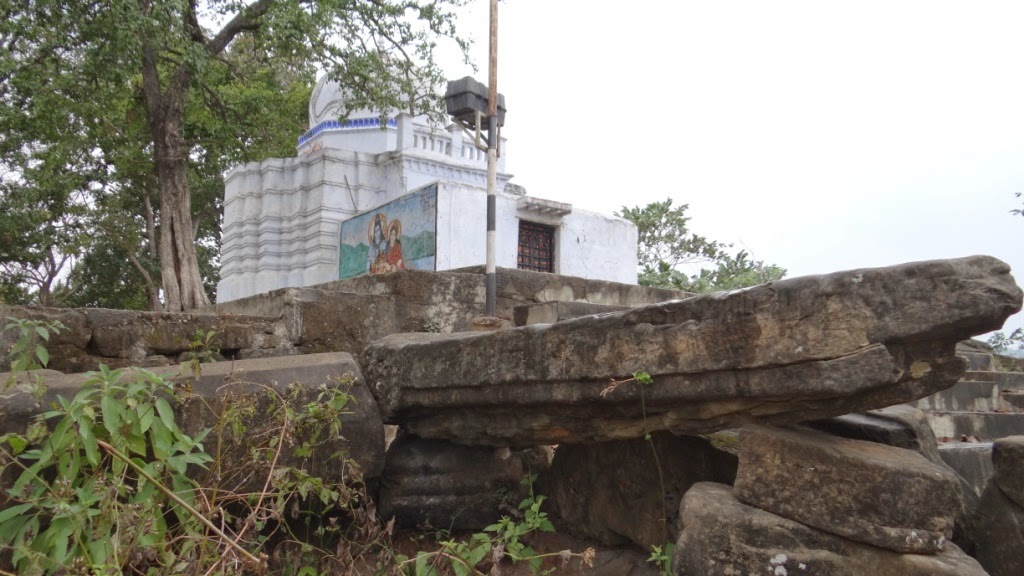
I as a part of a small documentation team from Nava Nalanda Mahavihara (NNM) first visited Pārwati Hill in 2006. The isolated hill is around 150 ft high; adjacent to the highway and a lush green landscape is visible from a distance. During the time of the Buddha (6th BCE), the base of this isolated hill was covered with a forest, a beautiful jewel railing (manivedikā), and hence it was called Vediya Parwat (Vediya hill) (DA.iii.697).  The sacred cave on the south side of the hill is mentioned as Indraśailaguhā (also Indasālaguhā) in Buddhist literature (D.ii.263, 264). The Chinese monk Xuanzang (7th CE) told how Lord Sakka asked the Buddha about matters relating to the forty-two doubts he had and how Lord Sakka recorded this in stone (Watters 2004). Another Chinese monk Faxian (5th CE) also makes mention of the tracings on the rock (Beal 2005: 111).

Shri Narendra Prasadji, the headmaster of the village school, told us to all the important places on the hill and its surroundings. Narendra Prasadji also shared with us how he was making efforts in generating awareness among the villagers towards the sanctity of the place. 

The place in spite of being associated with the Buddha was in a deplorable condition. Majority of the villagers were ignorant about the sanctity of the place and the hill was the most preferred place for open defecation. As a result the hill and its surrounding became a filthy place.   Also, the place received very few international and national Buddhist pilgrims each year and this was the prime reason why local people were not very enthusiastic about the place.
On 22nd Oct, 2009, NNM was given the opportunity to share its documentation of Buddhist sites in Bihar with the Chief Minister of Bihar and important state officials.  We shared with him how many of the sacred traces of the Buddha including Pārwati and Jeṭhian were in very bad shape and needed immediate attention. The Chief Minister took cognizance of this and Pārwati was brought under protection. (Bihar Ancient Monuments and ArchaeologicalSites, Remains And Art Treasures Act, 1976) 

On 22nd January, 2010, I got an opportunity to take the Hon’ble Chief Minister Shri Nitish Kumarji to visit Pārwati hill. The Chief Minister was very impressed with the site; he also got a firsthand glimpse of the sad situation of the place. Based on CM’s instructions, resources were allocated for the overall development of site under the 13th Finance Commission.

I am happy that the collective efforts of the local community, NNM and Department of Youth, Art and Culture (DACY), Government of Bihar, the Pārwati hill is now ready. A boundary has been created around the Hill for its protection. A ramp has been made for easy access to the top of the Hill and the sacred cave. A pilgrim facilitation centre is under construction and will be ready soon.


On my visit to the place on 20th June with Dr. Atul Verma, Director, Archaeology (DACY), I noticed  that the place was much cleaner than what it used to be earlier. Hopefully, the place will receive lots of pilgrims and hence livelihood opportunities are created for the local community. 


View from the sacred cave, Indraśailaguhā . The approach to the cave is now safe.

View from the sacred cave, Indraśailaguhā . The approach to the cave is now safe.
Boundary and tourist facilitation center under construction.
A ramp has been created that reaches to the top of the Hill.
Aditya Verma, Dr Atul Verma and I at Pārwati Hill
                                            --------------------------------------------
Development work at Pārwati is now almost complete. Another important village deeply associated with the Buddha that’s in queue for development is Jeṭhian. A development plan for the site is already submitted under the 13th Finance Commission and we hope the place will be ready by 2016.

The development of sacred Buddhist pilgrimage sites Pārwati and Jeṭhian will complete my long cherished dream of the Buddha trail connecting Bodhgayā-Prāgbodhi-Jeṭhian-Rājgir-Pārwati.
A catch-up meeting at Jehian
                                                       Some old memories        
Making presentation to Hon' Chief Minister, Shri Nitish Kumar Ji in 2009


With Hon' Chief Minister Shri Nitish Kumar ji at Pārwati Hill in 2010.

                           -----------------------------------------------------------------------------
Many villages in Bihar are settled over ancient remains. Villagers most of the times are ignorant about the importance of these mounds and hence in recent years many of the mounds have been lost and some are under threat of extinction. Apsaḍh is one such very important place associated with the Buddha where the heritage is under threat. Buddhist literature mention about a brāhmin village Ambasaṇḍā that was South of Pārwati hill and its villagers heartedly welcomed the Buddha’s stay in this area during his cārikā (D.ii.263f). Over the centuries the name Ambasaṇḍā got corrupted and it became Apsaḍh.

Though the entire Apsaḍh village is settled over the ancient remains, there lies a very prominent mound in the centre of the village. The entire mound is encroached and many huts and dwelling houses have come up over the mound. The Government of Bihar with help of community members of the village has created a boundary for its protection. Fencing and boundary is not the long-term solution. The real protection is possible only when the community of Bihar realizes the importance of this heritage and its need for preservation.
A boundary being created to protect the ancient mound.
The mound is in the center of the village.


Bibliography:

Beal, S.; 2005, Travels of Fah-hian and Sung-Yun, Buddhist Pilgrims from China to India, Low Price Publications, Delhi: (Originally published London: Trubner and Co.: 1869).

Watters, Thomas; 2004, On Yuan Chwang’s Travels in India, (Edited by T. W. Rhys Davids and S.W. Bushell), Reprinted in LPP 2004, Low Price Publications, Delhi. (First published by Royal Asiatic Society, London, 1904-05), ISBN: 81-7536-344-4.

Abbreviations of Bibliography:

 P.T.S.    Means published by the Pāli Text Society.

D.          Digha Nikāya, 3 vols. (P.T.S.).
DA.       Sumangala Vilāsinī, 3 vols. (P.T.S.).


Wednesday, March 11, 2015

Of Kites, Bribes and Relics

It has been a wonderful journey so far with my kite photographer friend, Yves Guichard. For the past eight years, we have been playing with a kite attached with a camera, viewing beautiful Buddhist monuments of Bihār and successfully capturing some breathtaking images of many sacred Buddhist sites in BihārOnce again after a gap of four years, we took the Mahāparinirvāṇa trail, the last journey of the Buddha. The objective was to once again capture some of the stūpas along this trail. Unfortunately, the weather forecast was not on our side. With cloudy weather when we left Nālandā on the 28th of February, we still wanted to take a chance that the weather would turn favourable the next day. The last journey of the Buddha started from Griddhakūṭa (Vulture’s Peak). Moving in stages he touched present day Silāo, Nālandā, Patnā then crossed the Ganges, stopping here and there until he reached Vaiśālī.


Our First stopover is a village called Birpur in Vaiśālī district.  Xuanzang visited many sacred places in the vicinity of Vaiśālī during his pilgrimage in the 7th CE. The places visited by Xuanzang in Vaiśālī may be broadly divided into six groups. Three of these include the Ashokan Pillar site, Royal Precinct and Relic Stupa that have been correctly identified. One was the place where Mahāpajāpati Gotami, the foster mother of Buddha, and also the first of the ordained Bhikkhuni, attained nirvāṇa. In the course of the GIS study of Xuanzang’s description, I realized that Birpur could be that place. A few elderly people of Birpur joined in to help us with the survey. With their help we reached a place that up until a few years ago had a few mounds. These had been bulldozed, apparently for the dirt that was needed to create a new railway track being laid. I felt bad. I was in Vaiśālī in 2010, surveying villages. Had I visited Birpur in 2010, the story would have been different; at least we could have taken some pictures for future research that an ancient mound had existed at this place.  A large part of the places mentioned by Xuanzang are still buried under layers of biomass. The initial revelation was led by some very enthusiast, passionate western explorers in the 19th and early 20th centuries. The entire work of exploration, excavation, conservation, etc was institutionalized and the ASI was formed. Identification, excavation and conservation is a time-taking process and might take centuries to reveal Xuanzang’s complete pilgrimage. To begin with, we should have had a projection of Xuanzang’s description completed by now and villages and places that fall under it being informed with an information board put in place. Awareness is the key.  Many of the heritage sites are vandalized out of ignorance and this could be avoided if we generate awareness. Unfortunately the passion and commitment with which the ASI was formed in the 1860’s is now lost, buried deeper than the archaeological remains itself.                                                                                                                                                 
Yves Guichard (in center) at Birpur
                                                                                                     Next, we reached Kesariyā, the place where stands a majestic 110 ft stupa to commemorate the offering of the bowl by the Buddha to the people of Vaiśālī. With efforts of Dr. K K Muhammad the process of scientific clearance of the Kesariyā mound was initiated in 2000. Due to some complications, the excavation was halted. It was a nice feeling to see the scientific clearance of the stupa being restarted. A very welcome news indeed; hopefully in next few years the complete stupa will be revealed.

We also captured the dark side (unexcavated side) of the Kesariyā stūpa. Not sensational news like the announcement of the first pictures of the dark side of the moon taken by soviet capsule Luna-3 in 1959, but to me this image of the unexcavated side of stupa is equally fascinating as it revealed part of the stupa. Just imagine a large lump of earth with dense vegetation in the middle of nowhere. This led to variety of local legends. Cunningham in 1861 was told by the local people that in ancient times King Bena along with his family burned himself inside the mound after his wife drowned in the nearby tank. Therefore, the Kesariyā mound was locally called ‘Rajā Bena ke deorā’. In an excavation in 2000, it was revealed to be a terraced stupa, one-of-kind in the Buddhist World.   
Aerial view of Kesariyā stūpa


                                                                                                      After we finished taking the pictures with the kite, I was approached by two officials who were supervising scientific clearance work of the Kesariyā stūpa. They told me that it is a ASI protected site and photography was not allowed. I should have taken their permission. They allowed us to take pictures and for that we should pay them Rs. 2000. Whooping large amount! They further added how all the tourists (mainly foreigners) pay them 2000 bucks for being allowed to take pictures. So much of easy money! Feeling envious of these guys!

Further north (of the Kesariyā stūpa) are remains of some huge structure, locally called as ‘rani ki vass’ meaning the Queen’s place.  Cunningham in 1862 saw a life size image of Buddha, a common feature south of Ganges (Magadha) but a rarity in the north of Ganges. This must be a very important pilgrimage place as remains are spread in a large area. The place was vandalized in the 1880’s and a large number of bricks were removed for some construction (Road?). On his second visit in 1881 he found the image of the Buddha missing. Cunningham reported ‘removed by a Bengali gentleman from Ramgarh Indigo Factory and its current whereabouts are unknown.’ Recently I was told that the Buddha image is kept at Indian Museum, Kolkotta. Does Bihār realize the kind of potential it holds in terms of Buddhist pilgrimage? All it has to do is to open ‘rani ki vaas’ mound (excavation) and reinstate the life-size Buddha from Kolkotta museum here (restoration). But I don’t see this happening anytime soon. It’s just too complicated!                                                               
'Rani ki Vaas' Mound
On 1st March we reached Sofā temple on the banks of the Pandai River.  The existing temple has been built over the remains of an ancient Hindu temple. We wanted to take an aerial picture of the temple but the wind was blowing too hard to play with the kite and soon it started drizzling. 
Sofā temple in the middle of river bed.


Sofā temple, new temple and the scattered ancient remains
                                                                                                       

                                                                                                       Our last stop of this Mahaparinirvana trail was the twin pillar site of Rampurwā. Rampurwā is the only place where two Ashokan Pillars have been discovered in close proximity. And this is very intriguing. I believe this site should be the true Kuśinagara, the place where the Buddha attained Nirvāa. For detail, you may visit my blog post Rampurwā: A compelling case of Kuśinārā.

At Rampurwā, I was extremely happy to see a Buddha statue installed over one of the stupa mounds. I was told by the local Hindu priest that a group of Vietnamese pilgrims enshrined this image last year.  So, it is no more only an Archaelogical site, the first step towards restoration of its livingness has begun.  For us these are ‘Ashokan Pillar’ (Inscribed or not) to them they are ‘Dhamma Pillars’ (the Pillars have Dhamma edicts). To us Ashoka installed them on trade routes but for them Ashoka marked sacred footsteps of the Buddha with Pillars with and without Dhamma edicts.

We say that it is a Buddhist circuit and Buddhist pilgrimage but instead, we promote them as an Archaeological site.   Interpretation does matter! These are living monuments, very sacred to the world. Awareness has to come; an opportunity for all of us to work upon. Let’s begin!!!
A newly enshrined image of Buddha at Rampurwā

Two Dhamma Pillars of Rampurwā

Seeking inspiration from King Ashoka.....his pillars were raised thousands of miles away from their quarries to motivate people to follow the Middle Path.

Tuesday, February 17, 2015

New Stūpa at Buddhavana (Ayer-Pathri)

Light of Buddha DhammaFoundation International (LBDFI) in its efforts to revitalize the lesser known but very sacred places associated with the Buddha in Bihar have created a stūpa near the Buddha cave at village ayer-pathri in Gaya district. The stūpa is blessed by US based Tarthang Tulku Rinpoche.


Most of the focus from government and non-government agencies towards development and promotion of the Buddhist heritage in Bihar is currently limited to the prominent sites like Bodhgaya, Rajgir, Nalanda and Vaishali.  While, many other prominent sites like Jethian, Juafardih, Ayer-pathri, Parwati etc associated with the sublime wandering of the Buddha are not getting the attention that they being associated with the Buddha deserves. 

Thursday, December 18, 2014

Visit of Venerable Ashin Nyanissara to Mahā Moggallāna Parinirvāṇa Stūpa, Juafarḍīh

5th Mahā Moggallāna Patha Padakkhiṇā Padayātrā

An  walk was organized to mark the occasion of Parinirvāṇa Anniversary of Magadhaputra, Iddhi Sammatho Mahā Moggallāna on  6th December, 2014. Venerable Ashin Nyanissara was the chief guest at the occasion.  Venerable Ashin Nyanissara has offered support towards development and restoration of the Mahā Moggallāna Parinirvāṇa Stūpa, Juafarḍīh.

Wednesday, December 3, 2014

Sculpture stolen from Ranabigha, Nalanda

The broken statue of the Buddha when found by the river bed in 2011. (now stolen)

Monday, December 1, 2014

Recovery of stolen 'Maher Buddha' sculpture

Telegraph, 1st December, 2014
Photographic documentation of undocumented ancient sculptures in villages of Bihar is being done under the 'Mapping of Nalanda, Rajgir and around' Project. The project by Nava Nalanda Mahavihara (NNM, Deemed University), Nalanda has finally begun to pay dividends. The three and half feet Buddha sculpture stolen from the village Maher, Gaya district in the first week of May, 2014 has been finally traced from a nearby village.   The Maher sculpture of the Buddha was already documented by NNM. The documentation of the sculpture by NNM   facilitated an effective FIR with the police and also helped in flashing the news of the theft in Newspapers and Internet. 


Tuesday, November 11, 2014

Kaṭhina-civara ceremony at Nava Nalanda Mahavihara (Deemed University)

                                                                                                  
A group of Tai Khamti Buddhist Community of Arunachal Pradesh celebrated Kaṭhina-civara function with monks, nuns, faculty and students of Nava Nalanda Mahavihara (Deemed University) and community of Nalanda.  
More than 30 lay Buddhist men and women under the Mrs. Protima Longphong from Arunachal Pradesh participated in the ceremony. The robe prepared by them was then offered to the Saṅgha of Nava Nalanda Mahavihara.


Khamti ladies preparing looms for weaving Chivara

Thursday, October 30, 2014

Nālandā Dhamma- A Vipassana centre now in Nālandā

For all those who don’t know what Vipassana is: 
Vipassana, which means to see things as they really are, is one of India's most ancient techniques of meditation. It was rediscovered by Gotama Buddha more than 2500 years ago and was taught by him as a universal remedy for all worldly ills. This non-sectarian technique aims for the total eradication of mental impurities and the resultant highest happiness of full liberation. Since the time of Buddha, Vipassana has been handed down, to the present day, by an unbroken chain of teachers. (Read more about Vipassana, the tradition and course)
For the Vipassana practitioners or those who know about it, there is good news!
Nava Nalanda Mahavihara (Deemed University) has transformed its sprawling 42 bedded guest house at Nava Nalanda Sanaskritik Gram into a Vipassana meditation center.  A series of 10-day seminar on Vipassana course in Nālandā has begun. The first 10-day course took place on 27th August to 7th August 2014. The course was conducted by Achārya Shri S S Tapariaji.   Twenty  eight participants, that include lay and monk students, faculty of NNM and local people participated in the course. The second course from 10th October to 20th October, 2014 also saw a good response and participants included three monks, four Vietnamese nuns, students and staff of NNM and community members from villages Ayer-Pathri and Jeṭhian (both ancient places are associated with the Buddha) successfully completed the course.
 
Next  ten-day courses,
1st to 11th December, 2014
1st February to 12th February, 2015
10th March to 21 March 2015
1st April to 12th April 2015 

Interested seekers may register/ enquire at drdlama@gmail.comneevda@yahoo.com